
GSM and Sex During Menopause: Why Sex Becomes Painful and What Can Help

Vanessa Tarfon
1 Oct 2026 – 4 min read

I talk a lot about the psychological side of sex because it’s so important. But what about when your body starts changing the rules without asking you first?
You haven’t suddenly stopped being attracted to your partner. You haven’t necessarily lost your libido. Your relationship might be perfectly fine.
But sex feels different. Maybe it’s drier, penetration feels uncomfortable, you need much more stimulation than you used to, you’re experiencing burning or irritation, or perhaps you’re finding yourself avoiding sex because, honestly, you just don’t want to deal with the discomfort.
Welcome to Genitourinary Syndrome of Menopause (GSM).
And if sex has started to feel different during perimenopause or menopause, you are not imagining it.
Hormonal changes can affect the vulva, vagina and urinary system, and those changes can have a very real impact on arousal, comfort, sensation, intimacy and desire.
GSM happens to every woman. But painful or uncomfortable sex is not something you simply accept because you’re getting older. And please don’t feel like you have to just grit your teeth and push through it. There are things you can do.
So, what is Genitourinary Syndrome of Menopause (GSM)?
Genitourinary Syndrome of Menopause sounds like an impressive medical term for something that can be surprisingly simple to explain.
Basically, when oestrogen levels change and decline during perimenopause, menopause and beyond, the tissues around your vulva, vagina, bladder and urethra can change too.
The vaginal and vulval tissues may become thinner, smoother, less elastic and less naturally lubricated. Blood flow can change, and the vaginal environment (pH levels) can change too.
And this matters because these tissues are involved in sexual arousal, sensation, comfort and pleasure.
So something that used to feel completely normal, like penetration, can suddenly feel dry, tight, scratchy, irritated or painful.
And that’s when sex can start to become a whole lot more complicated.
“But I don't actually have vaginal dryness…”
This is an important one. GSM doesn’t always show up as obvious dryness.
You might notice:
- Sex feels uncomfortable or painful.
- Penetration feels tighter than it used to.
- You need much more time to become aroused.
- You don’t seem to lubricate the way you used to.
- Your vulva feels more sensitive, irritated or uncomfortable.
- You experience burning or itching.
- You notice a small amount of bleeding after sex.
- Sex doesn’t feel as pleasurable or sensations feel different.
- You experience urinary urgency or more frequent urinary tract infections.
You might have one of these symptoms or several. Or you might simply have that vague feeling of “something isn’t quite right down there anymore.”
And that’s worth paying attention to.
Because you don’t need to tick every GSM symptom box before you’re allowed to ask for help.
And then there’s what GSM can do to your sex life…
GSM isn’t just about what’s happening to your vaginal tissue. It can affect the entire sexual experience.
Imagine sex starts to hurt. You remember that.
So the next time you’re thinking about sex, a little part of your brain goes: “Hmm… last time that hurt.”
You start anticipating discomfort.
Your body can become more tense.
It becomes harder to relax and become aroused.
You may produce less natural lubrication.
There is more friction.
Sex becomes even more uncomfortable.
And suddenly you’re thinking: “I just don’t feel like having sex anymore.”
And your partner might be thinking: “Does she not want me anymore?”
And you might be thinking: “What’s wrong with me? Where did my libido go?”
And around and around it goes.
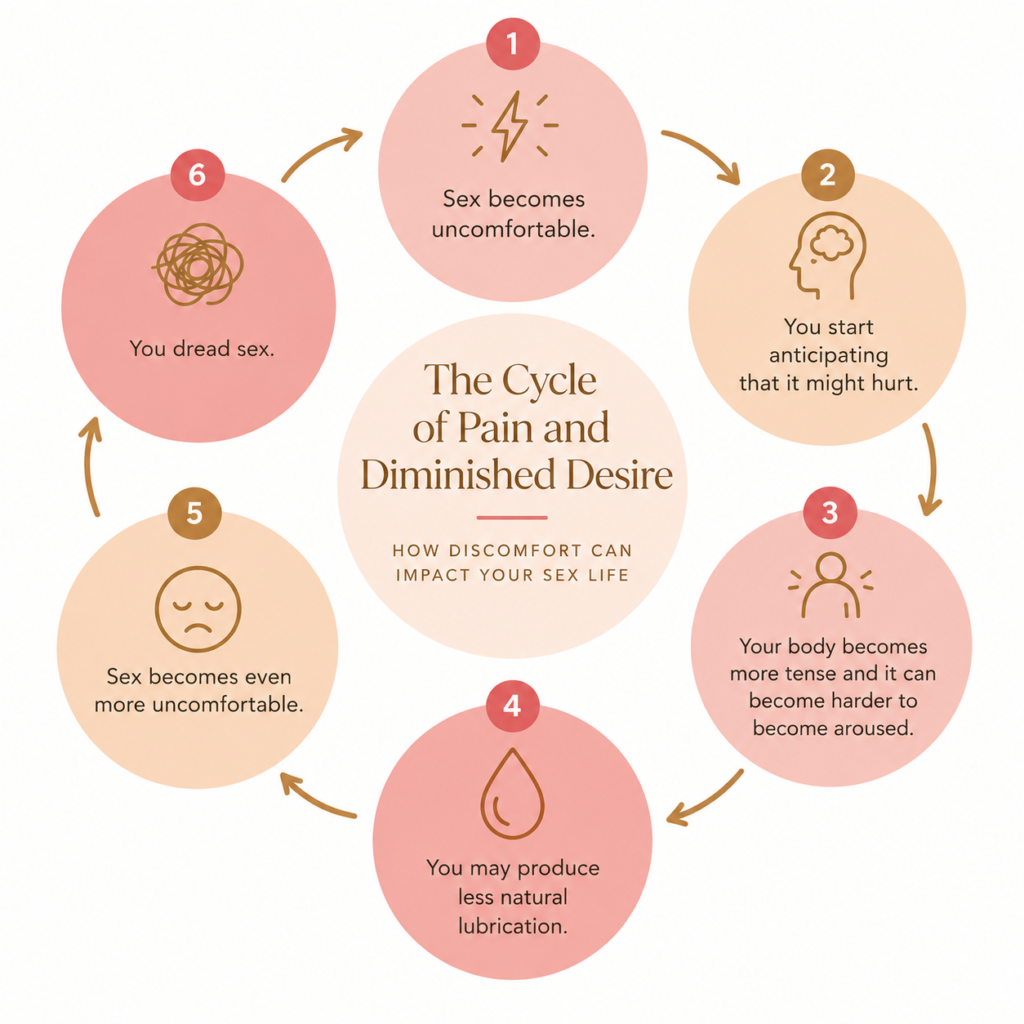
This is why I don’t want women to automatically assume that a change in desire means they’ve suddenly got “low libido”.
Sometimes what looks like a desire problem is actually a pain, arousal, hormonal or physical comfort problem. And that’s a very different thing.
It doesn’t necessarily mean you’ve lost your sexuality, or you’re no longer attracted to your partner. And it certainly doesn’t automatically mean something is wrong with your relationship.
Your body may simply be telling you:
“This doesn’t feel good anymore. We need to do something differently.”
What can you actually do to have sex with GSM?
First: stop pushing through pain. I know this sounds obvious, but so many women have been taught to tolerate discomfort when it comes to sex. If something hurts, you don’t get extra points for enduring it.
Instead, take the pressure off penetration for a while. This doesn’t mean giving it up, it means expand your definition of sex.
- Kissing
- Massage
- Oral sex
- Mutual stimulation / masturbation
- Toys
- Sensual touch and exploring each other’s full bodies to find those pleasure zones
There are plenty of ways to experience intimacy and pleasure that don’t involve penetration. Often taking penetration off the table can actually take away the pressure that has been getting in the way of arousal in the first place.
Then, when you do want to return to penetration, slow it down.
- Give your body time to feel fully aroused
- More stimulation
- More communication
- More lubricant
And much less expectation that sex needs to follow the same script it always has. Because your body might need something different now and that’s what we want otherwise sex becomes boring and mundane.
What about lubricant and vaginal moisturisers?
A good-quality lubricant can help reduce friction during sexual activity and make things more comfortable.
A vaginal moisturiser is different. It can be used more regularly to help with ongoing dryness and discomfort during your daily activities.
But if you’re regularly experiencing pain, irritation, bleeding or significant changes in comfort, don’t just keep buying different lubricants and hoping for the best.
Talk to your GP or another menopause-informed health professional.
What about vaginal oestrogen?
This is another option worth knowing about. For some women experiencing GSM symptoms, local vaginal oestrogen may be an appropriate treatment.
One example is Ovestin (estriol), which is applied vaginally and can help address symptoms associated with low oestrogen in the vulvovaginal tissues, including dryness and discomfort.
This is different from systemic menopausal hormone therapy (MHT), which circulates throughout the body and may be prescribed for a broader range of menopausal symptoms. Whether vaginal oestrogen, systemic MHT, both, or another treatment is appropriate depends on your individual circumstances, symptoms and medical history.
So this is one to discuss with your GP or menopause-informed health professional.
And if you’ve been quietly suffering because you assumed vaginal oestrogen “isn’t for someone like you”, please have the conversation before ruling it out.
And what about your pelvic floor?
When sex has been painful for a while, your pelvic floor muscles can start to respond protectively. You may find yourself tightening or bracing without even realising it, adding another layer to the discomfort.
This can be particularly relevant when penetration has become difficult or painful, including vaginismus, where the pelvic floor muscles involuntarily tighten around attempted penetration.
A pelvic health physiotherapist can be fantastic for helping you understand and work with the physical side of this. But you don’t necessarily need to stop there.
As a Sex Therapist, I can also help you work through the fear, anticipation, anxiety and avoidance around penetration, and gradually rebuild confidence and pleasurable sexual experiences.
Sometimes the goal isn’t to strengthen your pelvic floor, it’s to help your body feel safe enough to relax.
And for some women, a combination of pelvic health physiotherapy and sex therapy can be incredibly helpful.
Your sex life isn't over. It might just need an update.
Perhaps the biggest mindset shift is this:
You don’t have to get your “old” sex life back. Create a sex life that works for the woman you are now.
Maybe you need more time to become aroused, more stimulation, more lubricant or a different kind of touch. Maybe penetration isn’t the most pleasurable part of sex anymore. Maybe you need to communicate with your partner in ways you didn’t have to before.
None of this means your sexuality is disappearing.
In fact, midlife can be an opportunity to become more connected to your body, your pleasure and your desires. Yes, sex can actually become BETTER!
So if sex has become uncomfortable during perimenopause or menopause, don’t simply write it off as “getting older.”
GSM is common. It is treatable. And there is no expiry date on pleasure.
Vanessa Tarfon
Sex Therapist, owner of Authentic Awareness
Related Posts

Many women over 40 quietly accept less pleasure to keep the peace. Explore why women silence their sexual needs, the cost and how to fix it.

Orgasm still happening but weaker or harder to reach since perimenopause? Here’s why it changes, whether it improves, and what actually helps

A gentle, shame-free guide for women exploring their bodies and pleasure for the first time or in a long time, especially after 35.