
Intimacy and Pleasure After Female Genital Mutilation/Cutting: What Your Body Can Do

Vanessa Tarfon
1 Jul 2026 – 5 min read

Let me say that again because I want it to land. For my strong and brave women who have experienced Female Genital Mutilation or Cutting (FGM/C):
Your body has not been robbed of its capacity for pleasure.
Not a lesser version of pleasure. Not a consolation prize version. Real, full, alive pleasure.
I know that might feel impossible to believe right now. And I’m not going to gloss over the reality of what happened to you or what it might have cost you. But I am going to tell you the truth about your body, because you deserve that, and most people in your life have probably never given it to you.
As a qualified Sex Therapist based in Sydney, with a Masters in HIV, STIs and Sexual Health from the University of Sydney, I work with women across Australia navigating exactly this.
Are sexual feelings normal after FGM/C?
Yes. Absolutely yes.
Desire wasn’t cut away. It lives in your mind, heart, nervous system, hormones, and your history. It’s not kept in the part of your body that was altered. So, if you feel warmth, longing, curiosity, or a wish to feel good, that is normal. That belongs to you.
And if you don’t feel those things right now? That’s normal too. Your body may be protecting itself. That doesn’t mean desire is gone. It means it’s waiting for safety.
Your Clitoris Is Still There
This is the part that changes everything for women who have experienced FGM/C.
You have a clitoris, no matter what type of FGM/C you have experienced.
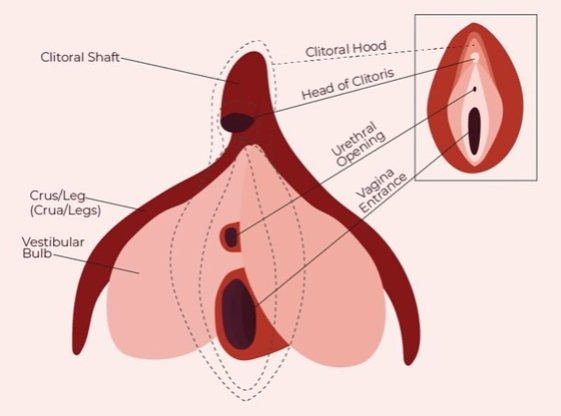
What most people picture as the clitoris is just the tip. A small external piece. But the clitoris is a much larger internal structure (shaped a little like a wishbone) with two inner legs and two pads of tissue that reach close to your vagina. Even if the visible outer part was cut, hidden or removed, the majority of your clitoris is still inside you, intact, full of nerve endings, doing exactly what it was designed to do.
And what is that? Bring you pleasure. Nothing else.
That means sensation, arousal, and orgasm are all possible. It might take more time, more patience, more exploration of what works for your body specifically. But the capacity is there.
Pleasure Lives Everywhere in Your Body
You don’t need a partner. You don’t need (or want) your genitals to be the starting point.
Your scalp, neck, inside of your arms, lower back, and behind your knees. These places are full with nerve endings that respond to touch, warmth and care, and for most women, beginning here is where everything starts to open up again.
Pleasure also lives in feeling safe, free from pressure or an agenda. That emotional safety isn’t a nice bonus, for many women who have experienced FGM/C, it is the whole foundation.
A satisfying intimate life after FGM/C isn’t about working around your body. It’s about coming home to it on your terms, at your pace.
Discover Pleasure After FGM/C: 3 Things You Can Start Doing Right Now
1. Get curious about your own body – all of it
In a private, comfortable space, get naked and spend time touching different parts of your body. Not just your genitals. Your arms, stomach, face, neck. Notice what feels neutral, what feels nice, what feels good. You can do this in front of a mirror or in the dark. There’s no goal, this is just you getting to know yourself. This is the first step in seeing yourself as a sexual person who deserves pleasure and enjoyment.
2. Let yourself feel what you feel without shame
When desire or arousal shows up, feeling warmth, a longing, a tingling, don’t push it away. Notice it. Say to yourself: “That’s desire, it’s normal, and it’s mine to feel.” Letting yourself acknowledge these feelings at all and without judgment is how you start building a healthier relationship with your own sexuality.
3. Redefine What Pleasure Means to You
Pleasure doesn’t have to mean penetration. It doesn’t have to mean a partner. It can be a slow self-massage, music that moves you, lying in bed breathing and tuning into your body and touch. Start with what feels safe and build from there. Your pleasure is yours to define, nobody else gets a say in that.
You Are Not Broken After FGM/C
FGM/C was done to you. It does not define what you can feel, what you can experience, or what you can enjoy.
Women who have experienced every type of FGM/C go on to have deeply satisfying, joyful, connected intimate lives alone and with partners.
If you want support, working with a Sex Therapist who understands FGM/C can make a significant difference. You don’t have to figure this out alone, and you don’t have to clench your way through it either.
My door is always open, no matter how big or small your question, reach out at hello@authenticawareness.com.au
Vanessa Tarfon
Sex Therapist, owner of Authentic Awareness
Related Posts

A gentle, shame-free guide for women exploring their bodies and pleasure for the first time or in a long time, especially after 35.

Revealing how your body image impacts your sex life and strategies to change your sexual self-confidence to revive your sexuality.

You’re in a sexless relationship and you don’t know how to get out of it? Find out here exactly how to get out of your sex slump!
FAQs: Intimacy and Pleasure After FGM/C
Yes. Always. The clitoris is mostly an internal organ, think of it like a wishbone sitting inside your body. The small external tip that may have been removed is only a tiny part of the whole structure. The internal legs and tissue remain, full of nerve endings, and able to respond to sensation and arousal.
Many can, yes. Orgasm is possible for most women who have experienced FGM/C, including Type I, II and III. It may feel different, take longer, or require more exploration of what works for your specific body, but the internal clitoral structure is still there and still responsive. However, that’s not the only way to have an orgasm. The capacity for orgasm was not removed.
Completely normal. Desire lives in your mind, nervous system and hormones, not in your genitals. Having sexual feelings after FGM/C doesn't mean something is wrong. It means your body is working exactly as it should.
For some women, yes particularly if there is scar tissue, tightening, or a narrowed vaginal opening. Pain during sex is not something you have to accept or push through. A gynaecologist or plastic surgeon experienced in FGM/C care, a trauma-aware pelvic floor physiotherapist, or a sex therapist can all help. Pain is a signal that support is needed, not a life sentence.
It can, but not always. Arousal is a whole-body response think increased heart rate, warmth, tingling, lubrication for example. Many women who have experienced FGM/C are surprised to find these responses are still very much present. If lubrication is reduced, this can also be influenced by hormones, stress, or anxiety rather than FGM/C alone. A good quality lubricant is always a good option.
No. Sexual wellbeing belongs to you, with or without a partner. Understanding your own desire, exploring what feels good, and rebuilding a relationship with your body are things you can do on your own terms and at your own pace. Solo exploration is not a runner-up prize. For many women it's where healing begins.
A Sex Therapist with FGM/C experience is often the best starting point, particularly for navigating intimacy, desire, and the emotional layers that come with it. Pelvic floor physiotherapy (trauma-aware) is valuable if there is pain or physical restriction. In Australia, organisations such as NSW Health, the African Women's Clinic and the Multicultural Centre for Women’s Health provide specialist clinical support. You don't have to piece this together alone.